
Stop Letting Your Agent Decide What It Needs to Know
Your agent has the tools. It just doesn't call them — and smarter models won't fix that. Here's why the unknown unknowns problem is the hardest challenge in agent context, and what to do about it.


Your agent has five tools. One of them — get_interaction_history — contains the single most important piece of context for the current request. The agent doesn't call it.
Not because it's broken. Not because the agent is bad at tool selection. Because nothing in the current message gives it any reason to.
Here's the scenario. A customer writes in to your e-commerce support agent:
"I want to return the shoes I bought."
The agent has access to lookup_orders, check_return_eligibility, get_loyalty_status, get_interaction_history, and get_return_history. Every fact it needs is one tool call away.
It calls lookup_orders. Finds the running shoes, Order #4521, purchased 45 days ago. It calls check_return_eligibility. The user is within their return window. It processes the return correctly, sends a shipping label, and closes the ticket.
What it missed: two months ago, in a completely separate conversation, this customer mentioned that this brand's sizing runs narrow for their wide feet. That fact — sitting in get_interaction_history — would have transformed the interaction. Instead of a generic return, the agent could have said: "Last time we chatted you mentioned the narrow sizing — would you like me to suggest a wide-fit option so we get it right this time?"
But why didn't the agent call get_interaction_history? Put yourself in the agent's position. Look at what it has at this point: the user said "I want to return the shoes I bought." It called lookup_orders and got back Order #4521 — running shoes, $129, 45 days ago. It called check_return_eligibility and got back "eligible." That's everything in its context. Is there anything here that hints at a conversation about foot width from two months ago? The order details don't mention it. The eligibility check doesn't mention it. The user's message doesn't mention it. There is simply no thread to pull on.
More generally, there are exactly two reasons an agent would ever call a tool like get_interaction_history.
The first: the agent has some reason to believe that relevant context is there. Something in its context — the conversation, prior tool results, the user's history — gives it a signal worth pursuing. But as we just saw, nothing in this scenario signals a two-month-old conversation about foot width. There's no breadcrumb. The agent would have to already know the fact exists in order to suspect it's worth looking for — and if it already knew, it wouldn't need to look.
The second: the agent has no particular reason to believe anything is there, but searches anyway — out of an abundance of caution, a blanket instruction, or a general heuristic to check broadly. This does surface the fact. But notice what happened: the tool call was completely disconnected from the user's query. It wasn't a targeted retrieval. It was a speculative sweep, hoping to find something that justifies its cost.
These are the only two possibilities. And unknown unknowns, by definition, can only be reached by the second — because the first requires a signal that doesn't exist.
Smarter Models Don't Fix This
The most common response to "my agent misses context" is to wait for the next model. GPT-8 will be smarter. Claude 7 will reason better. The problem will go away.
It won't. A smarter model might be better at signal-driven retrieval — better at picking up on subtle cues that relevant context exists, better at connecting dots across prior tool results. That's real progress. But no matter how smart the model gets, the binary still holds. Every tool call is either signal-driven or speculative. And for true unknown unknowns — context where there is genuinely no signal — a smarter model has exactly the same two options as a dumb one: find it by speculative search, or miss it entirely.
Model intelligence helps with Reason 1. It does nothing for Reason 2. And the hardest, most valuable context — the stuff that transforms a generic response into a great one — lives in Reason 2 territory.
The Tool Call Tradeoff
If the agent can't reliably decide which tools to call on its own, the natural instinct is to nudge it toward calling more. There's a spectrum of strategies here, and teams typically land somewhere along it:
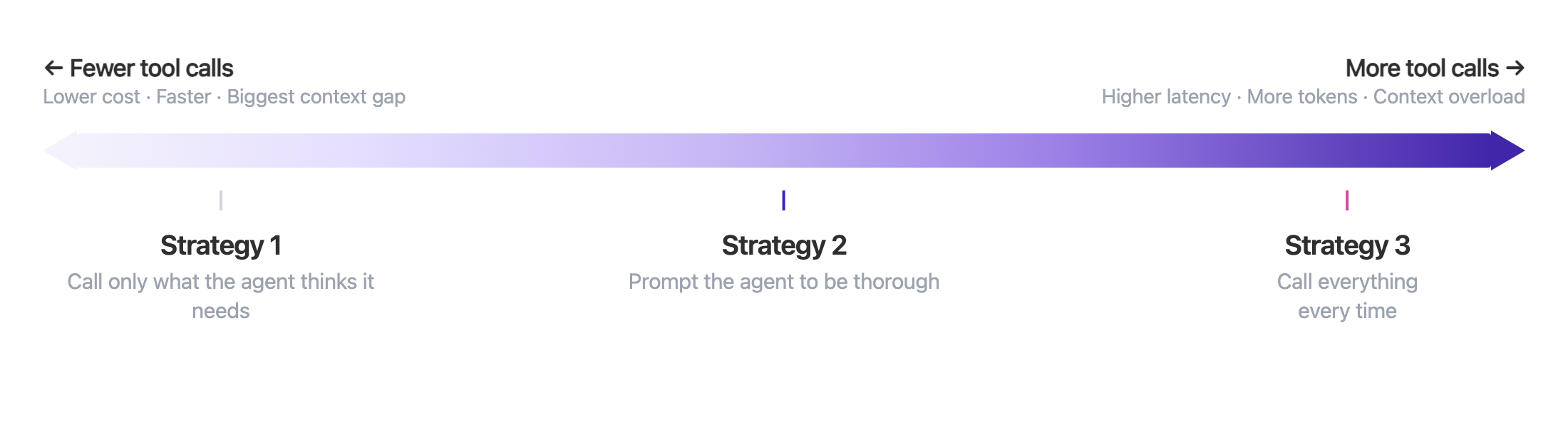
Strategy 1: Let the agent call only what it thinks it needs. This is the default. The agent reads the message, picks the tools that seem relevant, and calls them. It's fast and cheap. But as we've seen, it misses the context that isn't signaled by the current message — the wide-feet fact, the loyalty tier, the return history approaching a threshold.
Strategy 2: Prompt the agent to be thorough. You add instructions like "always check for relevant user history" or "when handling returns, also check the customer's past interactions." This catches some edge cases that the agent would otherwise miss. But it adds latency (every extra tool call is a round trip), token cost (the results go into the context window whether they're relevant or not), and cognitive load on the agent (more context to parse, prioritize, and potentially get confused by). And it only works for the cases you thought to prompt for.
Strategy 3: Have the agent call everything every time. Maximum coverage — but now the developer has to anticipate every tool that could ever be relevant to every possible message. You're also paying for all of it on every turn: the latency of multiple round trips, the tokens for results that are usually irrelevant, and the dilution of the agent's attention across a larger context window.
At every point on this spectrum, someone has to anticipate what context matters — either the agent (which can't know what it doesn't know) or the developer (who can't predict every possible user message). The unknown unknowns don't disappear. They just shift from one to the other.
What If the Agent Didn't Have to Decide?
The entire problem comes down to signals. The agent can only retrieve context it has a signal for — and the most valuable context often has no signal in the current message. Speculative search can fill the gap, but at unsustainable cost.
So what would the ideal system look like? It would utilize every available signal to retrieve relevant context, and deliver that context automatically on every agent turn — without the agent making a single tool call. This also eliminates the latency that tool calls bring, and removes the dependency on the LLM to correctly select tools.
Think about what signals are actually available beyond the current message:
- The user's identity is a signal. You're not talking to a random person — you're talking to this specific user, with a history, preferences, and patterns. A persistent user summary — their loyalty tier, communication style, account history — should travel with every interaction, regardless of what the current message is about. This is context that's almost always relevant and costs nothing to include.
- The domain the agent operates in is a signal. In e-commerce, return frequency matters. In healthcare, medication allergies matter. In financial services, risk tolerance matters. The system should be biased toward surfacing what's important in your specific business, even when the current message doesn't ask about it. Domain knowledge lets you prioritize what context is retrieved and how it's weighted.
- Relational connections between facts are signals. In a previous conversation about workout gear, this user mentioned they're training for a half marathon. That fact has virtually no semantic overlap with "I want to return the shoes I bought" — you wouldn't find it via embedding similarity search. But the relational path is clear: marathon training → running → running shoes → this order. It tells the agent this is an active runner who will need replacement shoes, turning a return into a retention opportunity. Following relational connections between facts surfaces context that text similarity alone would never find.
And when the system does return a fact, it should return the current truth, with the history behind it. If a user said they love Brand X six months ago and said they're done with Brand X last week, the agent needs the resolved, current fact — with temporal context showing how it changed — not just whichever version happened to rank higher in a vector search.
But don't tool calls give you iterative discovery?
With tool calls, the agent can chain retrievals: call one tool, learn something, use that to inform the next call. Doesn't removing tool calls from the equation lose that iterative discovery? Not if the system preconnects related context before retrieval time. Information that would be spread across multiple rounds of tool calls — order details linked to sizing complaints linked to brand preferences linked to return patterns — can be pre-identified and preconnected, so it arrives as one coherent block rather than requiring the agent to piece it together across several round trips.
The result: in our shoe return scenario, the agent receives the order details, the loyalty status, the wide-feet conversation from two months ago, the half-marathon training context, the return count approaching a review threshold, and the recent frustration from a shipping delay — all before it generates a single token. It doesn't need to decide to look for any of this. The system already did.
This is exactly what Zep does. Zep stores context in a context graph that preconnects disparate sources — conversations, business data, user behavior — into a unified structure. On every agent turn, it automatically assembles the most relevant context from that graph, combining always-on user summaries, domain-customized retrieval, graph-based relational search, and temporally resolved facts — so the right context is always there, even the context nobody thought to ask for.